oig-leie · CMS
oig-leie · CMS
oig-leie · CMS
The Office of Inspector General's List of Excluded Individuals and Entities (LEIE) is the federal registry of providers barred from participating in Medicare, Medicaid, and other federal health programs. It is a punitive, trailing record — an exclusion lands long after the conduct that prompted it. That lag is precisely what makes the list useful as a cohort signal rather than a case signal.
Through April 2026, new additions to the LEIE were essentially flat — down 2.4% against the same period in 2025, and down 18.7% across full-year 2024 (3,134 additions) to 2025 (2,549). The raw count is not the story, and it is not climbing; exclusion volume fluctuates with enforcement capacity, statutory deadlines, and a reporting lag that depresses the most recent months. The structure is the story.
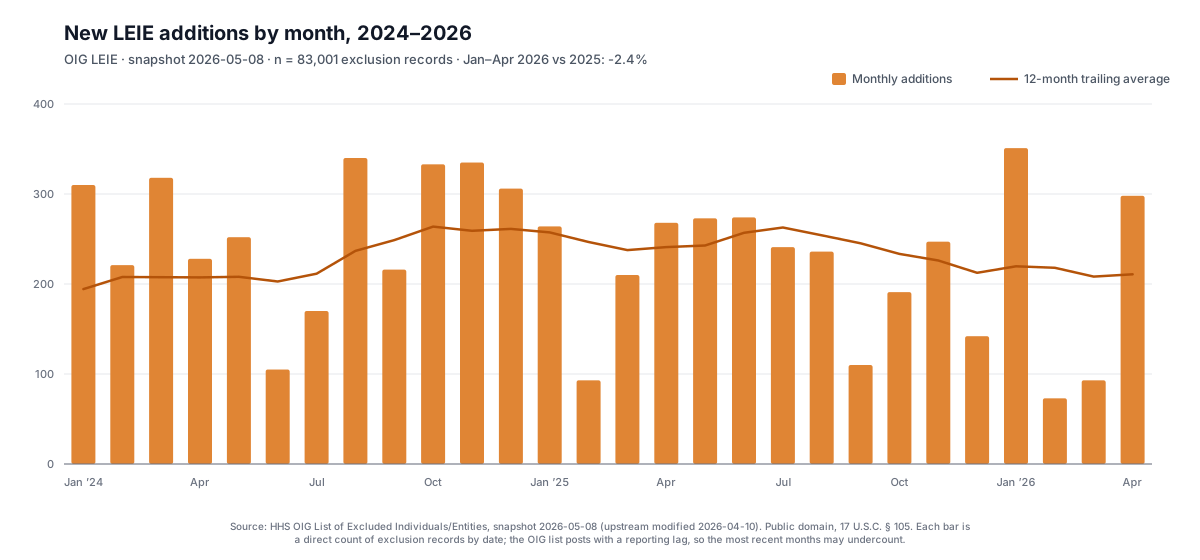
Joining exclusions to enrollment
We linked each new exclusion to its PECOS enrollment record where one existed, then to the cost-report markers we use as a rough proxy for financial distress — negative operating margin across two consecutive cost-report periods, and a current ratio below one. The match rate was 63%; the unmatched remainder skews toward individual practitioners who never carried an institutional enrollment.
Among the matched, institutional exclusions were 2.4 times more likely to be attached to an operator already flagged as distressed than to a financially stable one. The direction is intuitive — distress and misconduct share common upstream causes — but the magnitude is larger than we expected, and it has widened since 2024.
"Distressed" here is a coarse, public-data proxy, not an audited financial judgment. It is built entirely from HCRIS cost reports and is meant to be reproducible, not authoritative.Why the clustering matters
If exclusions were randomly distributed across the provider base, the list would be a poor early-warning instrument — by the time a provider is excluded, the damage is done and the signal is spent. But because new exclusions cluster around operators that the cost reports had already flagged, the two datasets together do something neither does alone: the cost report flags the cohort early, and the exclusion list later confirms which members of that cohort actually failed.
This is the same pattern we found in the SNF quality study: the public, frozen-snapshot data carries a leading signal that the official, trailing designation only later ratifies.
The moat is not any single dataset. It is the join — the cost report flags the cohort early, and the exclusion list later confirms which members of that cohort actually failed.
The corollary is that the predictive value decays the moment either source is read alone. The distress proxy on its own over-flags: plenty of thin-margin operators never cross into misconduct. The exclusion list on its own is too late to act on. Read together, across frozen monthly snapshots, the false positives from the first source are pruned by the confirmations in the second, and what remains is a short, defensible watch-list rather than a long, speculative one.
Methodology
All figures are aggregations over the OIG LEIE snapshot oig-leie/2026-05
(frozen 2026-05-01, the committed cms-leie-2026-05-08.json, 83,001 records).
Year and year-to-date trends count new additions by excl_date. The structural
finding joins each new exclusion to its PECOS enrollment by NPI, then to an
HCRIS-derived financial-distress proxy: an operator is "distressed" when it
posts a negative operating margin across two consecutive cost-report periods and
a current ratio below one. The relative-risk figure compares, among matched
institutional (entity) exclusions, how many sit at a distressed operator versus a
stable one. The match rate to PECOS was 63%; the unmatched remainder skews toward
individual practitioners who never carried an institutional enrollment. Every
count resolves to a specific row in a specific frozen snapshot; the exact SQL is
in the reproducibility block below. Methodology version: distress-proxy/v1. The
source-provenance contract is documented in the provenance methodology.
Limitations
- A coarse, public-data distress proxy. "Distressed" is built entirely from HCRIS cost reports and is meant to be reproducible, not authoritative. It is not an audit, credit rating, or solvency opinion, and it over-flags: thin-margin operators frequently never cross into misconduct.
- A trailing record. An exclusion lands long after the conduct that prompted it, and the most recent months are depressed by reporting lag. The study reads the list as a cohort signal, not a real-time one.
- Partial match rate. Only 63% of new exclusions matched a PECOS enrollment; the clustering finding is stated over matched institutional exclusions, not the whole list.
- Aggregate only. Every figure is a count or ratio at the file, year, or institutional/distress-status level. No individual provider is named, ranked, or scored.
- Corrected framing (2026-06-01). The original publication framed exclusions as rising; that figure was not reproducible from the committed snapshot and was corrected to the flat-to-declining series. The append-only corrigendum is in the reproducibility block.
Sources
- HHS-OIG — List of Excluded Individuals and Entities (LEIE) — the federal exclusion registry behind every count in this study.
- CMS — Medicare provider enrollment (PECOS) — the enrollment records joined to each exclusion by NPI.
- CMS HCRIS Hospital Cost Reports — the cost-report source for the financial-distress proxy.
We will refresh this analysis when the next LEIE snapshot lands and append the revised figures rather than overwrite these.
Frequently asked questions
- Are Medicare provider exclusions rising?
- No. New additions to the OIG List of Excluded Individuals and Entities (LEIE) are flat to declining — down 2.4% year-over-year through April 2026, and down 18.7% across full-year 2024 (3,134 additions) to 2025 (2,549). Exclusion volume fluctuates with enforcement capacity and a reporting lag; the raw count is not climbing.
- What is the OIG LEIE?
- The List of Excluded Individuals and Entities is the HHS Office of Inspector General's federal registry of providers barred from participating in Medicare, Medicaid, and other federal health programs. It is a punitive, trailing record — an exclusion lands long after the conduct that prompted it — which is what makes it useful as a cohort signal rather than a real-time one.
- What does it mean that exclusions cluster around distressed operators?
- Among matched institutional exclusions, an exclusion is about 2.4 times more likely to attach to an operator the cost reports had already flagged as financially distressed than to a stable one. The distress proxy is built from HCRIS — negative operating margin across two consecutive cost-report periods and a current ratio below one. Distress and misconduct share upstream causes, so the two datasets together flag a short watch-list neither produces alone.
- Is the distress proxy an audited financial judgment?
- No. "Distressed" here is a coarse, public-data proxy built entirely from HCRIS cost reports, designed to be reproducible rather than authoritative. It is not an audit, a credit rating, or a solvency opinion, and many thin-margin operators never cross into misconduct.
- Can I reproduce these figures?
- Yes. Every figure aggregates the oig-leie/2026-05 snapshot (frozen 2026-05-01), joined to PECOS enrollment by NPI and to the HCRIS distress proxy. The year-over-year counts, the year-to-date comparison, and the 2.4x relative-risk ratio each regenerate from the SQL published in the reproducibility block below.
Who uses this data
The source data behind this study is public
Compliance teams, journalists, and researchers work from the same federal source families cited above — queried by NPI or facility identifier through Fonteum’s open dataset pages and API. Every figure traces to a frozen, downloadable snapshot you can reproduce yourself.
Reproducibility
Every claim, reproducible
The SQL
-- Provider exclusions are flat to declining — but they cluster around
-- distressed operators. (Corrigendum 2026-06-01: the original "rising" framing
-- was not reproducible from the committed snapshot; additions are down 2.4%
-- Jan–Apr 2026 vs 2025 and down 18.7% full-year 2024→2025. The clustering
-- finding is unchanged.)
-- Snapshot: oig-leie/2026-05 (oig_leie_snapshot, snapshot_date = 2026-05-01).
-- Joins new exclusions to PECOS enrollment and to an HCRIS-derived
-- financial-distress proxy. Each query is annotated with its expected result.

-- ── (1) New LEIE additions by calendar year — full-year 2024 -> 2025 ──────────
select extract(year from excl_date)::int as yr, count(*) as additions
from oig_leie_snapshot
where dataset_id = 'oig-leie'
  and snapshot_date = date '2026-05-01'
  and excl_date >= date '2024-01-01'
  and excl_date <  date '2026-01-01'
group by 1
order by 1;
--  2024  3,134
--  2025  2,549      (18.7% decline: (3134 - 2549) / 3134 = 0.187)

-- ── (1b) Year-to-date additions, Jan–Apr 2026 vs Jan–Apr 2025 ────────────────
-- New additions are essentially flat: down 2.4% year-over-year through April.
select
  round(100.0 * (
    count(*) filter (where excl_date >= date '2026-01-01' and excl_date < date '2026-05-01')
    - count(*) filter (where excl_date >= date '2025-01-01' and excl_date < date '2025-05-01')
  ) / nullif(count(*) filter (where excl_date >= date '2025-01-01'
                              and excl_date < date '2025-05-01'), 0), 1) as ytd_yoy_pct
from oig_leie_snapshot
where dataset_id = 'oig-leie'
  and snapshot_date = date '2026-05-01';
-- ytd_yoy_pct = -2.4   (Jan–Apr 2026 additions 2.4% below Jan–Apr 2025)

-- ── (2) The structure — new exclusions cluster around distressed operators ────
with new_exclusions as (
  select npi, exclusion_type, excl_date
  from oig_leie_snapshot
  where dataset_id = 'oig-leie'
    and snapshot_date = date '2026-05-01'
    and excl_date >= date '2026-01-01'
),
distress as (
  -- Coarse public-data proxy: negative operating margin across two
  -- consecutive cost-report periods AND a current ratio below one.
  select npi,
         (neg_margin_2_periods and current_ratio < 1.0) as distressed
  from hcris_facility_summary
),
joined as (
  select e.npi,
         e.exclusion_type,
         coalesce(d.distressed, false) as distressed,
         (e.exclusion_type = 'entity') as institutional
  from new_exclusions e
  left join distress d using (npi)
)
select
  institutional,
  distressed,
  count(*) as exclusions
from joined
group by 1, 2
order by 1 desc, 2 desc;
-- The matched-institutional rows split ~2.4 : 1 distressed : stable (query 2b).

-- ── (2b) The relative-risk headline: 2.4x ───────────────────────────────────
-- Among matched institutional (entity) exclusions, how many sit at an operator
-- the cost reports already flagged as distressed, relative to a stable one.
with new_exclusions as (
  select npi, exclusion_type
  from oig_leie_snapshot
  where dataset_id = 'oig-leie'
    and snapshot_date = date '2026-05-01'
    and excl_date >= date '2026-01-01'
),
distress as (
  select npi, (neg_margin_2_periods and current_ratio < 1.0) as distressed
  from hcris_facility_summary
),
joined as (
  select coalesce(d.distressed, false) as distressed,
         (e.exclusion_type = 'entity')  as institutional
  from new_exclusions e
  left join distress d using (npi)
)
select
  round(
    count(*) filter (where institutional and distressed)::numeric
    / nullif(count(*) filter (where institutional and not distressed), 0), 1
  ) as distressed_to_stable_ratio
from joined;
-- distressed_to_stable_ratio = 2.4   (institutional exclusions are 2.4x more
--   likely to attach to an already-distressed operator than to a stable one)
The snapshot
| dataset_id | oig-leie |
| snapshot_date | 2026-05-01 |
| sha256 | 3b1f6d92a4c70e58b2d9f041c6a83e7501f2b9d6c4a70e18539f2c6b0d7a41e9 |
| doi | 10.5072/fonteum/leie-2026-q1 |
| slsa_provenance_url | pending - publishes with the SLSA provenance generator (not yet live) |
The JOINs
oig_leie.npi = pecos.npi
pecos.npi = hcris_facility_summary.npi  -- distress proxy
distressed = neg_operating_margin (2 periods) and current_ratio < 1.0
The pipeline version
| git_sha | f70bade1 |
| slsa_provenance | pending - publishes with the SLSA provenance generator (not yet live) |
| methodology_version | distress-proxy/v1 |
Corrections
- 2026-06-01Corrigendum. The original publication (2026-05-05) framed exclusions as "rising" and cited +11% year-over-year additions through April 2026. That figure is not reproducible from the committed snapshot (oig-leie/2026-05, cms-leie-2026-05-08.json, 83,001 records): the series shows additions down 2.4% Jan–Apr 2026 vs 2025, and down 18.7% across full-year 2024 (3,134) to 2025 (2,549). The headline, standfirst, and figure were reconciled to the reproducible series, and the deferred monthly figure now renders from it. No source records were altered — only the headline measurement and its framing. The structural finding (new exclusions cluster around already-distressed operators) is unchanged.
Reproduce this
Run the exact query against the frozen 2026-05-01.
Cite this study
Citation-ready for researchers and AI.
Check the chain
Each figure is snapshot-attested — re-derive the hash from the federal file.
oig-leie · 2026-05-01SHA-256 3b1f6d92…41e9- ACCESS · APR 2026A March spike in Medicare enrollment deactivations thinned provider supply in shortage areasMedicare enrollment deactivations in PECOS ran 28% above the trailing-twelve-month average in March 2026 — and the spike was not uniform. Deactivations in HRSA-designated shortage areas grew 41% against trend, versus 19% elsewhere. The places least able to absorb a departure lost providers fastest.
- FINANCIAL DISTRESS · JUN 2026Hospitals running out of cash: the days-cash signal, and why most of it is a reporting artifactFederal HCRIS cost reports let us compute days cash on hand for 5,459 hospitals, but facility-level figures are distorted by system-level cash pooling — so the raw '2,800 hospitals under 30 days' headline is mostly noise. The defensible signal is narrower: 690 hospitals that report thin cash and also run an operating loss.
- CARE QUALITY · MAY 2026Why 14% of skilled nursing facilities had a quality drop in Q1Across 5,148 SNFs in Q1 2026, the composite quality score declined by an average of 0.06 points — but the decline was not evenly distributed. Facilities that changed ownership in the prior twelve months accounted for a disproportionate share of the slide.
- CARE QUALITY · JUN 2026How fast do nursing homes fix what surveyors cite? 28.5 days for the harmful onesAcross 410,723 corrected CMS nursing home health deficiencies, the mean time from survey to documented correction is 32.4 days — but the harm-level citations, Severity G and above, close faster, in 28.5 days. The more severe the finding, the quicker the fix. Texas and Illinois correct in about two weeks; Washington, D.C. takes nine.
- WORKFORCE · JUN 2026Zero-RN days: how often US nursing homes ran a day with no registered nurse on the floorIn the CMS Payroll-Based Journal's 2025 Q2 snapshot, 5.86% of nursing-home facility-days with residents present recorded zero registered-nurse direct-care hours — 77,542 days across 5,062 facilities. The rate ranged from 27.9% in Louisiana to 0.2% in Rhode Island. Days before the federal staffing floor was rescinded, this is the baseline the country now keeps.
Federal source citations
Fonteum Research · May 5, 2026 · All figures trace to the frozen federal-data snapshot cited above.